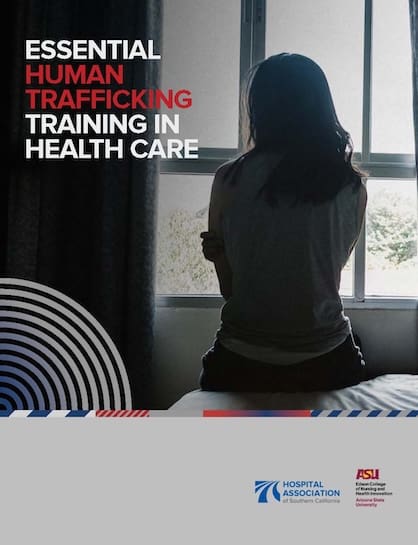

Please note new location for this workshop
What if you’re the only person who notices?
Health care providers are often the first — and sometimes the only — professionals who interact with human trafficking survivors (NCBI/PMC; HEAL Trafficking). When you know what to look for, you could help someone turn their life around.
Learn how to spot potential trafficking survivors and offer compassionate care at Essential Human Trafficking Training in Health Care.
They’re already in your ED. Will you know how to help?
Trafficking survivors come into the ER with “sports injuries,” vague complaints and someone else who speaks for them. They’re hoping you’ll read between the lines. This workshop gives you the tools to recognize the signs and respond with care that could save a life.
The course is for:
- Physicians, nurses and clinical staff
- Registration and intake personnel
- Social workers and chaplains
- Health care administrators
- Anyone who interacts with patients
You don’t need to be a clinician to make a difference — you need awareness, confidence and a clear framework.
What You’ll Leave With: Skills You’ll Use Right Away
Recognize the signs:
- Health indicators linked to trafficking
- Red flags in patient interactions
- Patterns specific to trafficking
- What to notice during intake, triage and clinical care
Respond with confidence:
- Trauma-informed communication techniques
- How to create safe moments for disclosure
- Questions to ask (and how to ask safely)
- Documentation that protects survivors and your practice
Connect to resources:
- Your role in intervention and referrals
- Building relationships with allied organizations
- Legal considerations and mandated reporting
- Developing protocols for your organization
Real-world Application
Through case studies and group discussion, you’ll practice applying these skills in scenarios you’re likely to face in your own setting.
The Full Picture: Equity and Trafficking
Human trafficking doesn’t affect all communities equally. While these crimes trap people of all genders, cultures, races and backgrounds, they unduly impact people of color, LGBTQI+ youth and other marginalized communities.
This training approaches trafficking through a social and racial justice lens, empowering you to:
- Understand systemic factors that make some groups more vulnerable
- Recognize signs across all skin types and backgrounds
- Provide culturally responsive, trauma-informed care
- Use inclusive language that affirms dignity
- Account for the intersectional challenges survivors face
Equity is a core part of the curriculum — ensuring you’ll leave with frameworks that center survivors’ well-being and honor their full humanity.
Why this Training Matters
The statistics are sobering. Your response can help change them.
- Health care settings are one of the most common places trafficking survivors seek help — often several times before disclosure (NCBI/PMC)
- Most survivors interact with a health care provider while being trafficked, yet few are identified (HEAL Trafficking)
- Southern California has one of the highest rates of trafficking in the country
This problem is just outside your door and in your ED. You’re preparing for patients you’ll see at any moment. When you recognize them, you open a door to freedom.
CEUs
Continuing education units offered:
- Society for Human Resources Management (SHRM) PDCs: Hospital Association of Southern California is recognized by SHRM to offer Professional Development Credits (PDCs) for SHRM-CP® or SHRM-SCP® recertification activities. This program is valid for 3.50 PDCs for the SHRM-CP® or SHRM-SCP®.
- California Board of Registered Nursing (BRN): This activity has been approved for 3 contact hours of continuing education for Registered Nurses by Hospital Association of Southern California, an approved BRN provider (Provider CEP-970).
- American Medical Association (AMA) PRA Category 1 Credits: 3 CME credit hours
- Nursing Continuing Professional Development (NCPD) Credits: 3 credit hours
- Social Work Approved Continuing Education (ACE): 3 credit hours
- Interprofessional Continuing Education Credits (IPCE): 3 credit hours

As a Jointly Accredited Organization, Arizona State University is approved to offer social work continuing education by the Association of Social Work Board’s (ASWB) Approved Continuing Education (ACE) program. Organizations, not individual courses, are approved under this program. State and provincial regulatory boards have the final authority to determine whether an individual course may be accepted for continuing education credit. Arizona State University maintains responsibility for this course. Social workers completing this course will receive 3 credit hours of continuing education credits.
Program Details
Please view the tabs below for more details.