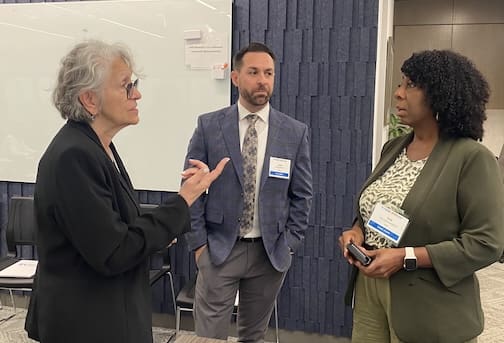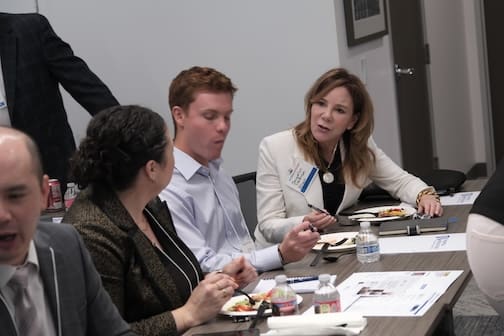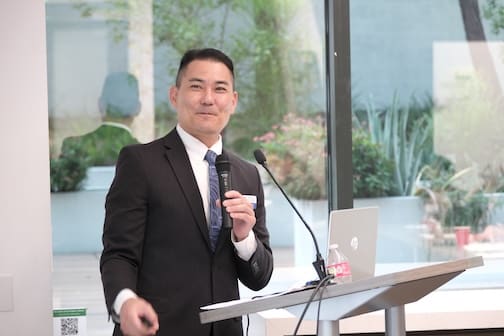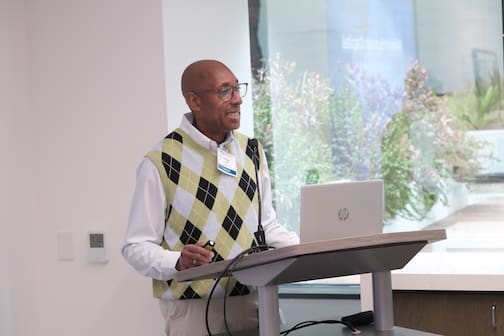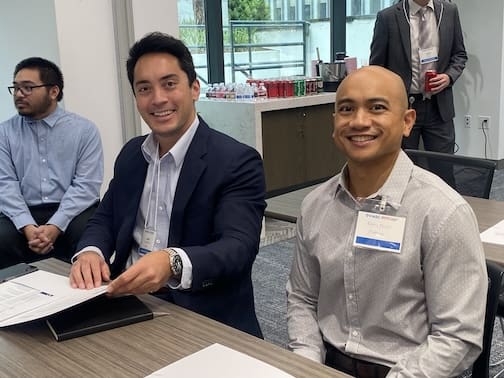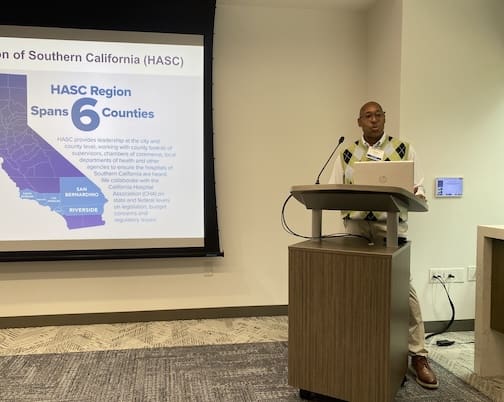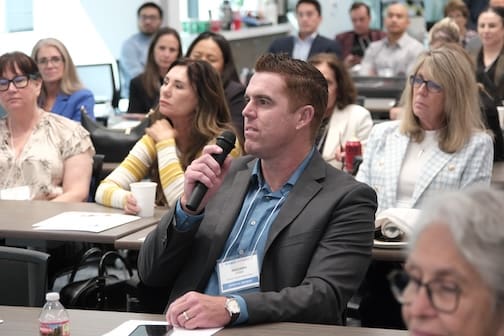
HASC’s annual Associates and Partners Event brought close to 50 Associate Members, Education Partners and Endorsed Business Partners to downtown Los Angeles on Wednesday, Sept. 16. After enjoying a networking lunch, attendees heard how hospitals are addressing a rapidly shifting coverage landscape and where partners can help.
George Greene, HASC president and CEO, welcomed the group and opened with an overview of the association’s current work, touching on the challenges hospitals are facing. Paul Young, HASC’s chief of advocacy and public policy, then dove deeper into those realities, giving more details about the financial hurdles hospitals are navigating and how they’re responding.
Young began with a message that set the tone for the afternoon. The Medi-Cal coverage cliff has already arrived, following implementation of the One Big Beautiful Bill Act (OBBBA). Medi-Cal enrollment in Los Angeles County peaked at 4.7 million in 2023, dropping by roughly 1.1 million since and returning to pre-Affordable Care Act levels. UC Berkeley’s projected worst-case scenario for LA County, a loss of over one million members by 2028, has already happened, and statewide, Medi-Cal has lost about three million people.
A major Medi-Cal change will take effect on Jan. 1, 2027. About two million Californians with unsatisfactory immigration status (UIS), including more than 550,000 in LA County, will transition from managed care back to the traditional fee-for-service program. In so doing, they will lose access to enhanced care management and community supports. The asset limit also fell from about $130,000 to $21,000, pushing many seniors accessing long-term care services off the program. Young noted that twice-a-year eligibility redeterminations will speed coverage losses, since counties can’t keep up with the volume.
Razor-thin Margins
These losses are hitting hospitals already operating with little cushion. Regional operating margins are just 1.3% to 1.4% — comparable to grocery stores, Young said. Half of hospitals run in the red in any given year, with wages climbing about 60% over the past decade, and physician fees, supplies and other costs rising faster than inflation. Uncompensated care is projected to double by 2030.
Policy changes are also adding pressure. Beginning this year, the Office of Health Care Affordability (OHCA) caps hospital revenue growth at three and a half percent annually, even as costs rise five to six percent. The California Hospital Association projects that the cap will pull $44 billion from the system over four years, with penalties beginning in 2028. OBBBA also limits Medi-Cal directed payments, taking an estimated $3 billion from California hospitals in 2025 and $16 billion over four years.
What’s Next
Young said hospitals are likely to consolidate service lines. Labor and delivery units without heavy patient loads may close, and pediatric beds may convert to medical/surgical for adults. Outpatient and home health services are expected to grow as baby boomers continue to gray and the Medicare population keeps expanding. HASC is encouraging cross-system cooperation, similar to the model used by Dignity Health, so closures don’t leave communities without care.
Open Forum
Following Young’s presentation, a range of questions arose during the open forum. An attendee from a small post-acute facility said their per-diem rates haven’t changed in 40 years and called for regulatory relief and stronger investment in the full continuum of care. Others asked for real-time visibility into Medi-Cal eligibility so providers can help patients before their benefits lapse during a stay. Young said HASC is pursuing that request county by county, mentioning Inland Empire Health Plan’s data-sharing arrangement as a model.
Addressing a question about reducing hospitals’ load through keeping people healthier, Young highlighted HASC’s work through the National Health Foundation to address social determinants of health, along with transformation hubs focusing on increasing primary care access and residency slots. He also noted the cost shift from Medi-Cal to commercial payers under the new OHCA hospital growth cap.
The Importance of Partnerships
The afternoon’s discussion underscored how closely hospitals and their partners are connected, and that cross-sector collaboration will be vital in meeting the challenges ahead.
“Our associates and partners all play an important role in supporting our member hospitals across Southern California,” said Katrina Quinto, director, membership services, HASC.
“By helping them better understand the financial and operational pressures our hospitals are facing, we hope to inspire fresh ideas and practical, collaborative solutions that we can build together,” she said. “With a clearer view of these challenges, our associates and partners can better tailor their support in ways that make the greatest impact for our hospitals.”
Thank you to everyone who took part in this year’s Associates and Partners Event and made it a success. We look forward to continuing these conversations with our associate members and partners in the year ahead.